As an Amazon Associate, we earn from qualifying purchases. Some links on this site are affiliate links at no extra cost to you. Our recommendations are based on thorough research and editorial judgment.

The History of Indian Ink and Its Permanence

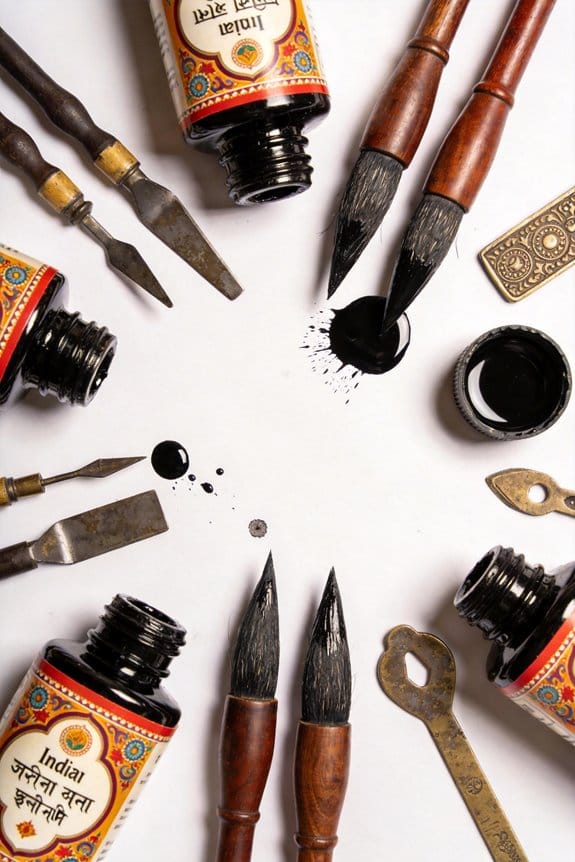
Indian ink, originating in ancient China around 3000 BCE, has evolved into a highly valued medium. Its composition mainly consists of fine carbon black, creating rich black pigment known for its longevity. This permanence is due to the quality of carbon used, which resists fading and degradation over time. Indian ink‘s versatility makes it suitable for various artistic styles and techniques. If you’re curious about its uses and practical applications, there’s much more to explore.
Key Takeaways
- Indian ink originated in ancient China around 3000 BCE and was known as “masi” in India, highlighting its historical significance.
- Its composition mainly consists of fine carbon black, ensuring longevity and resistance to fading.
- The ink’s durability has been proven as historical Chinese inks have survived for centuries without degradation.
- Different formulations, including varying binding agents, allow for waterproof or non-waterproof applications while maintaining permanence.
- Indian ink’s strong, permanent finishes facilitate secure layering in artwork and various fields, boosting its practical usage.
The Ancient Origins of Indian Ink
You may be interested

When it comes to Indian ink, it’s pretty wild to think about how it all started way back in ancient China around 3000 BCE. This ink wasn’t just for scribbles; it was what people used for both writing and painting. They made it from carbon black, which came from burning things like pine wood or even animal bones. The traditional way to whip up this ink was to mix that soot with a binding agent like animal glue, giving it a tough consistency that became waterproof once it dried. Let’s face it, artists loved it for that reason!
Over in India, they called it “masi,” which shows just how widespread this ink was. It’s more than just a cool fact; the influence of Indian ink went beyond China, impacting places like Egypt and Greece as well. These civilizations recognized the value of carbon black in their own inks too. So, why does this matter? Understanding the roots of Indian ink can deepen your appreciation for the art and writing tools we have today.
If you’re ever curious about experimenting with inks yourself, consider trying to make your own. Here’s the trick: start with a simple recipe using soot and a binding agent you have around. You’ll get a taste of this ancient practice, and who knows, you might discover a new passion for art.
In short, Indian ink has such a rich history that connects so many cultures. For artists interested in fine detail and lasting results, using high-quality sable brushes can enhance the application and permanence of their ink work. What’s your favorite way to express yourself creatively?
The Historical Evolution of Indian Ink

Have you ever stopped to wonder where Indian ink comes from? It’s more than just a simple material for drawing or writing; it has a rich, fascinating history that stretches across thousands of years and different cultures.
To start, Indian ink’s roots trace back to ancient China, where it was known as sumi ink in Japan. By the mid-17th century, European traders brought Indian ink to the West, typically made from a mix of carbon black and animal glue. It’s interesting to note that the ancient Egyptians and Greeks were mixing carbon black into their ink recipes long before that. Dioscorides, a Greek scribe, even crafted an ink blend that’s still recognized today!
India’s contributions to ink history are noteworthy too. There’s “masi,” a type of black ink made from ashes and animal glue, dating all the way back to the 4th century BCE. So, why does this matter? Because as Indian ink made its way into Europe, it didn’t just stay the same; it blended with local practices, enriching its role in monochrome paintings and artistic works around the globe.
The best part is that knowing this background can help you appreciate your own artistic endeavors even more. Each time you put pen to paper with Indian ink, you’re participating in a centuries-old tradition that threads across cultures and time. So, next time you’re sketching or journaling, think about the journey of that simple ink!
To wrap it up, Indian ink isn’t just a tool; it’s a connection to history. How might this understanding change the way you create? Also, artists often use acid-free mat boards to preserve and frame their ink artworks, ensuring the longevity and integrity of these timeless pieces.
Composition and Characteristics of Indian Ink
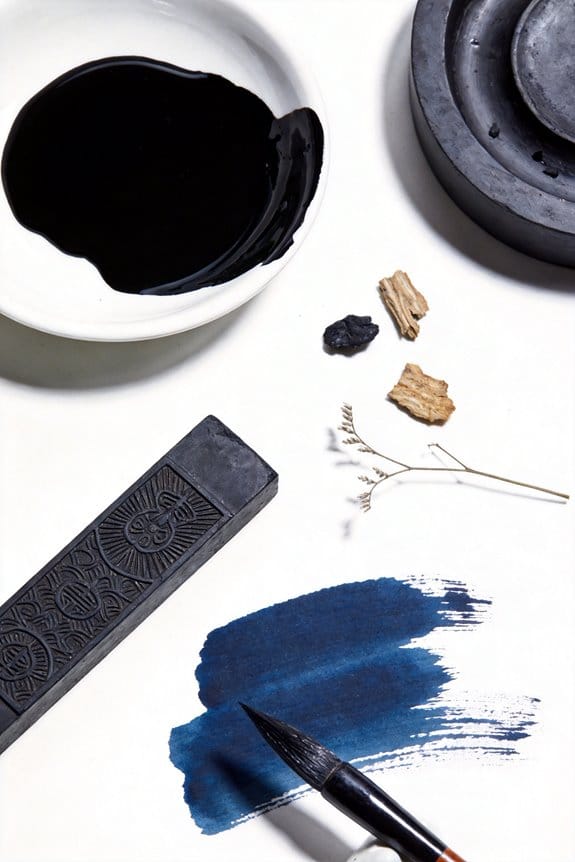
Have you ever tried using Indian ink? It’s an incredible medium that many artists and writers have loved for years. At its core, Indian ink is made from fine carbon black, usually sourced from lampblack. This gives it a rich opacity that lasts over time. Depending on your needs, you can also find variations that use different binding agents like animal gelatin or shellac.
Want to know a neat trick? With different binders, you can get both waterproof and non-waterproof inks. The carbon black particles in the ink create a colloidal suspension, which means you don’t always need extra binders for stain effects. This flexibility affects important things like how the ink flows, how opaque it appears, and how fast it dries.
Modern versions might add synthetic pigments to improve water resistance and tackle clumping issues, while still maintaining that classic Indian ink charm. Why should you care about these details? Understanding the makeup of Indian ink makes it easier for you to choose the right type for your projects. For artists preparing surfaces, using primers like acrylic gesso enhances adhesion and longevity of their artwork.
Recommended Products

Large Canvas Wall Art:This beach wall art will take you back to the soft sand and breezy winds,and bring a touch of the beach's beauty into your home.This seascape wall art showcases that starfish,conch and hermit crab resting on beach along with a drifting bottle,seashell,coral,beautiful daisy floral bloom in a vase.This ocean wall art will fit in your room of choice and be a true focal point to inspire the mood of the room

Features: Permanent waterproof ink with a velvet matte finish; Available in 1 oz., 16 oz., and 32 oz. sizes, the blackest India ink you can buy, lightfast and archival carbon black, water-based formula, AP Certified non-toxic, and made in the USA

💝Golf course wall art size: 60Wx40H inch. Each panel size: 12x20inchx2,12x28inchx2,12x40inchx1,golf canvas prints easy ready to hang.
Why Is Indian Ink Renowned for Its Permanence?
Have you ever used an ink that fades just a few months after you’ve created something special? It’s frustrating, isn’t it? That’s why Indian ink is a favorite for artists and anyone who values longevity in their work. What sets it apart? Well, the secret lies mainly in carbon black, which is highly resistant to fading and degradation.
Take a look at historical Chinese inks; many documents have survived from the Han dynasty, showing just how well they’ve held up through the centuries. Indian ink often includes shellac as a binder, which boosts its water resistance. This feature makes it so versatile. You can use it for everything from traditional calligraphy to modern illustrations, and it won’t let you down.
So, what’s the deal with the drying process? The colloidal suspension of carbon particles in Indian ink dries to a strong finish. Once it’s dry, you can count on it being lightfast, giving you those deep, true black lines that don’t fade.
The best part? If you want your art or documents to withstand the test of time, Indian ink is a solid choice. Thanks to its unique properties, it’s not just for fancy projects—it’s practical for everyday use too. Many artists prefer inks that offer waterproof and fade-proof qualities to ensure durability in their work.
Recommended Products

【Artwork Size】The total size of this canvas wall art is 60"x40"(12"x20"x2, 12"x30"x2, 12"x40"x1). The canvas painting pass multiple inspections and is packaged in quality box so that they arrive in your hands intact.

Framed Wall Art Size:40"Hx60"W (40H x 20Wx3) Dimension:(100x150cm).

Artistic Uses of Indian Ink
Have you ever struggled to find the right medium that gives your artwork a timeless feel? Indian ink might just be what you’re looking for. This medium is popular among artists because it features a deep black pigment that really makes drawings pop. Famous names like William Hogarth and Andy Warhol have used this ink to create everything from sharp, clear lines to soft, layered effects similar to watercolors.
It’s not just about the look either. Indian ink offers a unique tactile experience as you can adjust shading and texture based on your brush strokes. When it dries, it gets even better—it’s permanent! That means you can mix it with watercolors without worrying about smudging your work.
If you’re looking to expand your artistic skills, consider giving Indian ink a try. Whether you’re using a dip pen or a brush, it can really enhance your artistic expression. You can experiment with various techniques to find a style that suits you. Using mediums such as acrylic flow mediums can also help improve the fluidity and finish of your artwork, offering enhanced paint flow for smooth, professional results.
Recommended Products


BRAND Faber-Castell is globally renowned and loved. They are a world leading manufacturer of top-quality, innovative art materials. Faber-Castell have become the go-to brand for artists, for centuries, whether professional or hobbyist

BRAND – Faber-Castell is globally renowned and loved. They are a world leading manufacturer of top-quality, innovative art materials. Faber-Castell have become the go-to brand for artists, for centuries, whether professional or hobbyist.
Unexpected Applications of Indian Ink Beyond Art
Have you ever thought about the many uses of Indian ink beyond just art supplies? It might surprise you to learn just how versatile this ink can be in various fields. For instance, in the medical world, it plays a crucial role in permanent tissue staining. This helps medical professionals visualize cellular structures under a microscope when studying tissues.
In scientific research, Indian ink is used for negative staining, which makes pathogens much easier to see. This is super important in microbiology studies where clarity can change everything. You might even find it surprising that NASA saw potential in Indian ink back in 2002, patenting its reflective properties for metallic polishing. This innovation helps enhance aluminum mirrors to achieve top-quality optics!
You may not know that dried Indian ink has conductive properties. This means it can be used in electronics for things like low-frequency shielding. So, if you’re into tech, pay attention! Plus, in Japanese culture, you can find Indian ink in games like Hanetsuki, where it marks the losing players.
Truth is, Indian ink has carved out a unique niche for itself in various practical applications. Whether it’s aiding researchers or even influencing cultural games, its impact goes far beyond the art world. Have you encountered any surprising uses for common items lately? Like many acrylic paints, Indian ink’s fast-drying properties make it convenient for quick application and layering in various settings.
Recommended Products

Indium Tin Oxide ITO-Pen Conductive Film for Touch Screen Laboratory Use 195 x 255 mm, 2 pcs/Package
🍏 Size: 195 mm (W) × 255 mm (L); Thickness: 0.125 mm. Transmittance(Visible light): ≥ 81%; Sheet resistance: 6 ohm/sq (4-point probe). The film can be easily cut with scissors to the required size. Please remove the protective film before use. Customized sizes are available upon request.

Creates strong permanent electrical connections
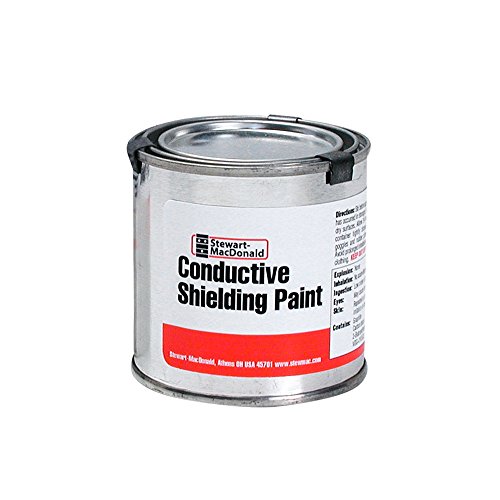
REDUCES HUM & NOISE: Creates a conductive shield that eliminates unwanted hum, noise, and radio interference from guitar electronics
Getting Started With Indian Ink in Your Art
Ever thought about diving into the world of Indian ink for your art projects? It can feel a bit overwhelming at first, but once you get the hang of it, there’s so much you can do with it. Start off by giving your ink bottle a good shake to ensure you get that perfect, even consistency. When you’re ready to use a dip pen, make sure to dip just the nib. This keeps the ink from gumming up your pen, which can be a real pain later on.
Now, if you want to mix things up, consider using brushes! They can create all sorts of fun textures and effects with Indian ink. Want a softer look? Try mixing the ink with water for beautiful washes or layering effects. The best part is, once it’s dry, Indian ink becomes waterproof, so you don’t have to worry about smudging your hard work.
Cleaning up should definitely be a part of your routine too. After you finish your masterpiece, take a moment to clean your nibs and brushes. Trust me, preventing dried ink buildup will save you a lot of hassle down the road. Using quick-drying ink also helps prevent smudging while working on your art.
Recommended Products

Set of 12, 1. 0 oz glass bottles with droppers and mixing palette
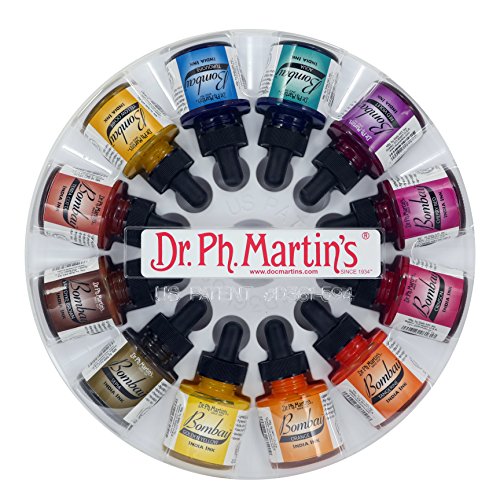
Set of 12, 1.0 oz glass bottles with droppers and mixing palette

20 COLORED INDIA INKS: This Liquidraw ink set includes 20 bottled colors - black, blue, violet, red, green, orange, brown, lemon yellow, magenta, maroon, yellow, pink, olive, parrot green, burgundy, lavender, grey, light pink, tan & white
Frequently Asked Questions
What Is the History of Indian Ink?
Indian ink’s history intertwines with Indian culture, influencing ink production and artistic techniques. From ancient manuscripts to calligraphy styles used by popular artists, trade routes expanded its reach, showcasing its modern applications and enduring cultural impact.
Is Indian Ink Permanent?
Yes, Indian ink’s permanence is attributed to its durable formulations and chemical composition. We find its fading resistance and archival quality surpasses many other inks, making it a preferred choice for artists, especially under environmental effects.
What Is so Special About India Ink?
India ink’s special because its ink composition supports diverse writing styles and calligraphy techniques, enhancing artistic expression. Its cultural significance and historical usage in various artistic mediums make it a favorite for many creators.
What Is the Origin of Indian Ink Stain?
The origin of Indian ink stains lies in its ink composition, crafted from soot and animal glue. We’ve seen its traditional applications in art, reflecting cultural significance and evolving through global variations and modern adaptations.


